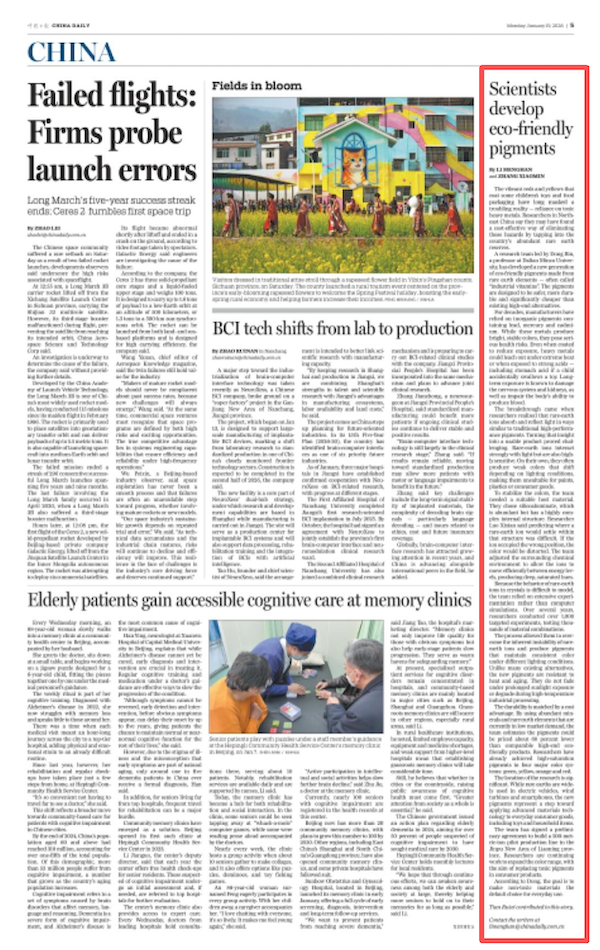
1月19日,《中国日报》(China Daily)英文版报道我校董斌教授团队立足我国稀土资源优势,突破传统颜料局限,成功研发出全新一代环保颜料。面对“传统无机颜料虽然色彩稳定,却因重金属添加而存在健康风险隐患”的难题,团队选择“宽带隙基质+稀土掺杂”的技术路线,经过上千次有针对性的实验,通过精准调控稀土离子的光学行为,实现绿、黄、橙、红四大色系的高饱和度呈色,且具备耐高温、抗老化、色牢度强等性能。目前,团队已与大连金普新区达成初步合作意向,通过校地合作建立500吨级试验生产线实现量产,并计划从建筑外墙、跑道、陶瓷、汽车涂料等与民生密切相关的领域切入,让“无毒替代”走进普通消费品领域。
The vibrant reds and yellows that coat some children's toys and food packaging have long masked a troubling reality — reliance on toxic heavy metals. Researchers in Northeast China say they may have found a cost-effective way of eliminating those hazards by tapping into the country's abundant rare earth reserves.
A research team led by Dong Bin, a professor at Dalian Minzu University, has developed a new generation of eco-friendly pigments made from rare earth elements — often called "industrial vitamins". The pigments are designed to be safer, more durable and significantly cheaper than existing high-end alternatives.
For decades, manufacturers have relied on inorganic pigments containing lead, mercury and cadmium. While these metals produce bright, stable colors, they pose serious health risks. Even when coated to reduce exposure, heavy metals could leach out under extreme heat or when exposed to strong acids — including stomach acid if a child accidentally swallows a toy. Longterm exposure is known to damage the nervous system and kidneys, as well as impair the body's ability to produce blood.
The breakthrough came when researchers realized that rare-earth ions absorb and reflect light in ways similar to traditional high-performance pigments. Turning that insight into a usable product proved challenging. Rare-earth ions interact strongly with light but are also highly sensitive. On their own, they often produce weak colors that shift depending on lighting conditions, making them unsuitable for paints, plastics or consumer goods.
To stabilize the colors, the team needed a suitable host material. They chose silicoaluminate, which is abundant but has a highly complex internal structure. Researcher Luo Xixian said predicting where a rare-earth ion would settle within that structure was difficult. If the ion occupied the wrong position, the color would be distorted. The team adjusted the surrounding chemical environment to allow the ions to move efficiently between energy levels, producing deep, saturated hues.
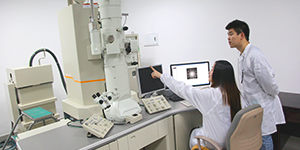
Because the behavior of rare-earth ions in crystals is difficult to model, the team relied on extensive experimentation rather than computer simulations. Over several years, researchers conducted over 1,000 targeted experiments, testing thousands of material combinations.
The process allowed them to overcome the inherent instability of rare-earth ions and produce pigments that maintain consistent color under different lighting conditions. Unlike many existing alternatives, the new pigments are resistant to heat and aging. They do not fade under prolonged sunlight exposure or degrade during high-temperature industrial processing.
The durability is matched by a cost advantage. By using abundant minerals and rare earth elements that are currently in low market demand, the team estimates the pigments could be priced about 60 percent lower than comparable high-end eco-friendly products. Researchers have already achieved high-saturation pigments in four major color systems: green, yellow, orange and red.
The location of the research is significant. While rare earths are widely used in electric vehicles, wind turbines and smartphones, the new pigments represent a step toward applying advanced materials technology to everyday consumer goods, including toys and household items.
The team has signed a preliminary agreement to build a 500-metric-ton pilot production line in the Jinpu New Area of Liaoning province. Researchers are continuing work to expand the color range, with the aim of replacing toxic pigments in consumer products.
According to Dong, the goal is to make non-toxic materials the default choice for everyday use.
Tian Ruixicontributed to this story.
原文链接:https://enapp.chinadaily.com.cn/a/202601/19/AP696d7f41a310d93d63cc108b.html

 检测到当前浏览器版本过低,这会影响网站的显示效果,
请升级浏览器以获得更好的浏览体验。
检测到当前浏览器版本过低,这会影响网站的显示效果,
请升级浏览器以获得更好的浏览体验。
 图书资源
图书资源






 加入民大
加入民大 校园信息
校园信息 友情链接
友情链接